
Beam Splitters and Polarization Beam Splitters
Photonchina supply a wide range of Beam Splitter and Polarization Beam Splitter products.
Beamsplitters are used to split or combine beams of light. Cubes are a convenient, protected form for various applications. Plates, with their low absorption, are sometimes chosen for laser applications. . The PBS (Polarizing Beamsplitter) series is ideal for applications requiring active polarization control. Ultimately, the performance of any beamsplitter is primarily determined by the specifications of its coating.
| BEAMSPLITTER | SPECTRUM | PROPERTIES |
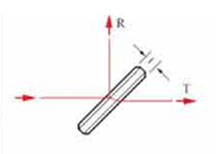
| Beamsplitter Plate (BS Plate) | Broadband Wavelength | Compact design and simple structure; the optical wedge beam splitter, based on the beam-splitting flat plate, reduces interference from back-surface reflected light. Beamsplitter plates can sometimes be used with high power lasers. When using beamsplitter plates, it is important to bear in mind that the two partial beams travel different optical paths. The optical paths depend on the incident angle and the thickness of the plates. |
| Single Wavelength | ||
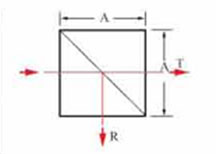
| Beamsplitter Cube (BS Cube) | Broadband Wavelength | Compare with beamsplitter plates, beamsplitter cubes have the following advantages: -Identical path lengths for both the reflected and the transmitted beams -The transmitted beam is neither display nor deflected -Stable and compact -Easy operation -Easy to mount / align |
| Single Wavelength | ||
| Penta Beamsplitter Cube | Broadband Wavelength 630-680nm T/R: 20%/80% ±5%Single Wavelength | The penta beamsplitter is composed of a penta prism and a wedge. Like the beamsplitter cube, it has the following properties: -The transmitted beam is neither display nor deflected – Stable and compact -Easy operation |
| Polarizing Beamsplitter Cube (PBS Cube) | Broadband Wavelength | The prism can be used as polarizers, beamsplitters, or beam combiners. The output beam, which is parallel to the input beam, is called a p-polarized beam while the orthoganal output beam is defined as the s-polarized beam. Essential for polarization extraction, optical isolation, laser cavity coupling, and other scenarios requiring active polarization control. |
| Single Wavelength | ||
| Non-Polarizing Beamsplitter Cube (NPBS Cube) | Broadband Wavelength | Splits light at a defined intensity ratio while meticulously preserving the original polarization state of the incident light in both output beams. |
| Single Wavelength | ||
| Polarization Beam Combiner (PBC Cube) PBS+Half Waveplate | 375,405,532,633,780,808,850,880 915,975,1064,1310,1550nm or customize | The polarization beam combiner consists of a polarizing beam splitter (PBS) and a 1/2 waveplate. It can combine two incident polarized beams that are either parallel or perpendicular to each other into a single beam. |
How to choose above products in a right way for your applications? see here
1 Beamsplitter Plate Capacity
| ATTRIBUTE | STANDARD | PREMIUM |
| MATERIAL | BK7 | BK7 |
| DIMENSION TOLERANCE | ±0.1mm | ±0.02mm |
| THICKNESS TOLERANCE | ±0.1mm | ±0.02mm |
| FLATNESS | Per 25.4mm λ/4 @ 632.8nm | Per 25.4mm λ/10 @ 632.8nm |
| SURFACE QUALITY | 60-40 scratch and dig | 10-5 scratch and dig |
| PARALLELISM | <20 arc seconds | <5 arc seconds |
| T/R | T=(Ts+Tp)/2,
R=(Rs+Rp)/2 T/R=50/50, 80/20, 70/30, 90/10, 60/40 ±5% @ λ c or λ b | T=(Ts+Tp)/2,
R=(Rs+Rp)/2 T/R=50/50, 80/20, 70/30, 90/10, 60/40 ±3% @ λ c or λ b |
| COATING | λ c: Single wavelength, λ b: Broadband wavelength | |
2 Beamsplitter Cube Capacity
| ATTRIBUTE | STANDARD | PREMIUM |
| MATERIAL | BK7 | BK7 |
| DIMENSION TOLERANCE | ±0.2mm | ±0.1mm |
| FLATNESS | Per 25.4mm λ/4 @ 632.8nm | Per 25.4mm λ/10 @ 632.8nm |
| SURFACE QUALITY | 60-40 scratch and dig | 20-10 scratch and dig |
| T/R | 50/50 ± 5% | 50/50 ± 2% |
| BEAM DEVIATION | <3arc minutes | <30arc seconds |
| COATING | Specified wavelength or T/R | Specified wavelength or T/R |
3 Polarizing Beamsplitter (PBS) Capability
| ATTRIBUTE | STANDARD (Low Power) | PREMIUM (High Power) |
| MATERIAL | BK7, SF2, H-ZF3, Corning 7980. | BK7, SF2, H-ZF3, Corning 7980. |
| DIMENSION TOLERANCE | ±0.2mm | ±0.05mm |
| SURFACE QUALITY | 60-40 | 20-10 |
| BEAM DEVIATION | <3 arc minutes | <30 arc seconds |
| EXTINCTION RATIO | >500:1 | Narrow Band>3000:1 Broad Band>1000:1 |
| PRINCIPAL TRANSMITTANCE | Tp>95%, Ts<1% | Specify |
| PRINCIPAL REFLECTANCE | Rs>99%, Rp<5% | Specify |
| COATING | AR on all input and output surfaces PBS. Coating on hypotenuse (broadband wavelength: 450-680, 650-850, 900-1200, 1200-1550, 1500-1610nm, etc.) | Specify |
SPECIALITY: Photonchina is able to provide High Power PBS of various wavelength, which can bear great laser power (~ 15J / cm2 @ 1064nm, 20ns, 20Hz), as well as high extinction ratio.
Here is stock availability and detailed specifications of PBS products in Photonchina.
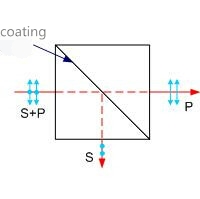
Shown above, it is coated with a multilayer interference film on the slope of the right-angle prism, and then glued or optical bonding into a cubic structure to transmit the incident P-polarized component and the S-polarized component.
Features of Polarization Beamsplitting Products:
Separate horizontal polarization and vertical polarization of a beam of light;
The ratio of the transmittance of P to S light is greater than 1000, and the P light transmittance is above 90%.
Small stress, high extinction ratio, good image quality and small beam deflection angle.
The wavelength covers the 420-1600 nm region.
Used in such occasion as polarizing, analyzing, light intensity adjustment etc. It is a key component in projection system, imaging system, optical instrument and optical measurement system.
Limitations of PBS
It should be noted that the working effect of the polarization beam splitting prism, is wavelength limited. Further, PBS is only an element for roughly selecting polarization, and if the precision demand of polarization is high, a Glan Thompson Polarizer or the like can be used.
4. Non-Polarizing Beamsplitter (NPBS) Capability
| ATTRIBUTE | STANDARD | PREMIUM |
| Material: | N-BK7; Fused Silica | |
| Dimension X×Y: | 1×1mm~25.4×25.4mm | |
| Dimension tolerance: | ±0.1mm | ±0.03mm |
| Parallelism: | <20 seconds | <5 seconds |
| Clear Aperture: | 85% | |
| Surface Quality: | MIL60-40 | MIL20-10 |
| Flatness(per 25.4mm): | λ/4@ 632.8nm | λ/10@ 632.8nm |
| T/R(for random porlarization)T=(Ts+Tp)/2;R=(Rs+Rp)/2: | 50/50±5% | 50/50±2% |
| Bevel(face width×45°) : | Protective bevel or specified by customer | |
| Coating: | Narrow band or 400~700; 700~1100; 1100~1600(nm) | |
| Available beam splitting ratio | 8/2, 7/3, 6/4, 5/5, 4/6, 3/7, 2/8, 1/9 | |
Non-polarizing beamsplitter is a kind of special polarizing beamsplitter. It makes the p-polarization component and S- polarization component of incident light have similar spectral characteristics.
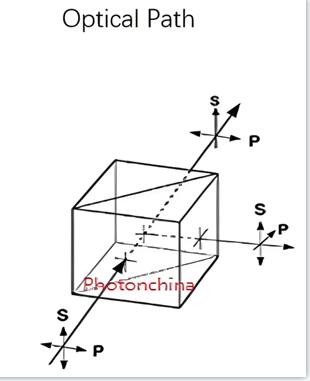
The optical coatings have been designed to hold both the s and p-polarization components to the same ratio of reflection-to-transmission over a specific laser wavelength region. This means that they will not change the state of polarization of the incident beam. All input and output surfaces are coated with a high efficiency anti-reflection coating.
Features of Non-Polarization Beamsplitting Products:
- The ratio of horizontal polarization and vertical polarization of incident light should be maintained as much as possible after splitting by the NPBS.
- The degree of separation for optical properties of P and S is less than 5%, Dispersion is low and the color neutrality is good.
- The wavelength covers 400-1600nm, which is widely used in interferometers and various imaging instruments.
- Non-polarization beamsplitter is very useful for randomly polarized light as it is specially designed to minimize the polarization effect.
Photonchina can provide both narrow-band and broadband NPBS. Please see here for detailed product information.
5. Polarization Beam Combiner (PBC) Capability
| Material | Fused Silica, N-BK7 ,Quartz Crystal |
| Size | 1×1x1mm~50.8×50.8×50.8mm |
| Clear Aperture | 90% |
| Surface Quality | 40-20 |
| Flatness | λ/8@ 632.8nm |
| Beam Deviation | <3′ |
| Structure | Optical Bonding |
| Extinction Ration | >1000:1 (>30dB) |
| Coating | Tp>98%,Rs>99.5% |
| Wavelength | 375,405,532,633,780,808,850,880 915,975,1064,1310,1550nm or customize |
| Damage Threshold | 12 J/cm2 @ 1064nm 10ns, 10Hz |
Note: Unless prior request from customers, H-K9L, JGS1, the Chinese equivalents of N-BK7 and Corning 7980, will be used in real production.
Principle:
The polarization beam combiner consists of a polarizing beam splitter (PBS) and a 1/2 waveplate. It can combine two incident polarized beams that are either parallel or perpendicular to each other into a single beam: a 45° half waveplate first converts the S-polarized laser into P-polarized light. The two mutually perpendicular S- and P-polarized beams are then merged into one polarized beam by the polarizing beam splitter prism.
Please see here for detailed product information.
Photonchina offers two types of Polarization Beam Combiners for the market. One is for the Orthogonal Optical Path, and the other is to work with the Parallel Optical Path.