
The imaging principle of rigid endoscope is mainly based on optical lens imaging system and fiber optic light guiding technology, which is a pure optical imaging method that can achieve image transmission without electronic sensors (such as CMOS or CCD). Rigid endoscopes are widely used in medical, industrial testing and other fields, especially suitable for direct view detection tasks with simple structure, high definition and real-time requirements. The endoscope lenses’ design and quality, such as Photonchina’s endoscope lens products, are one of the core technologies that directly affect imaging quality and use effectiveness.
A rigid endoscope typically consists of the following parts:
Objective Lens
Located at the front end of the probe, responsible for collecting the light emitted or reflected by the measured object and forming an initial inverted real image.
Imaging lens group/Relay Lens System
Composed of multiple sets of lenses (such as Grimes lenses or rod lenses) arranged along the endoscope shaft, it is used to gradually transmit the image formed by the objective lens to the eyepiece end.
Eyepiece or camera adapter
Located on the handheld end, it can be directly observed by the operator or connected to a camera to convert optical images into electronic signals, putting them on the display.
Working principle of objective lens
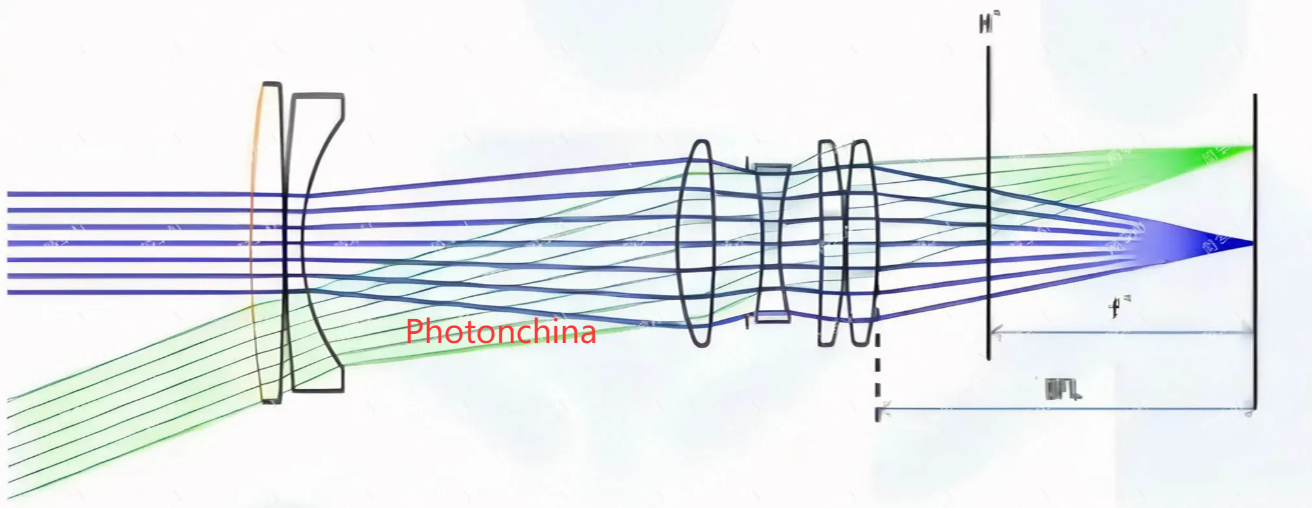
From the perspective of image formation
1. Objective imaging stage
The object being detected is within a certain working distance in front of the probe, and the objective lens (usually a convex lens) focuses the light emitted by the object, forming an inverted and reduced real image behind it.
The objective lens is composed of multiple lenses, which determine the resolution and imaging clarity. The resolution of the objective lens is affected by the aperture, wavelength of the light, and lens quality.
By using different lens combinations and filter designs, white light and fluorescence imaging can be achieved through 400-650nm (white light) or 400-900nm (white light+near-infrared light).
By precise design and innovation, for instance, aspherical technology, objective lenses correct imaging aberrations such as spherical aberration, coma, positional chromatic aberration, astigmatism, field curvature, distortion, etc., obtaining higher quality images.
2. Relay Imaging stage
Due to the long length of endoscopes (several tens of centimeters or even longer), it is not possible to directly transmit images to the end, so a relay lens system is required for multiple “transfers”.
The relay system usually consists of several pairs of lenses (or optical rod lenses), and the function of each set of lenses is:
Relay the real image formed in the previous stage to the next real image;
Maintain the clarity and orientation of the image (achieve final positive image through odd number of inversions).
Common designs such as Grubbs lens or Photonchina’s Rod lens have high transmittance and low distortion.
Assuming that the relay system contains three sets of lenses, the image will be inverted three times and ultimately presented as an upright image (odd number of inverted images=positive image).
3. Eyepiece. Visual or electronic imaging output.
The ocular lens is located at the rear end of the endoscope, allowing the operator to directly view or connect to the camera for video output. It usually includes a magnifying lens to help users see the image transmitted through the relay lens system more clearly.
Other optical components in endoscopic systems
Prisms.
In addition, endoscopic systems often use other types of optical components such as prisms, windows, filters etc.
Common prisms include Dove prism, Roof prism, Right angle prism, etc. For more details on prism products, please visit here.
Windows.
Sometimes, a transparent protective window is also installed in front of the objective lens to prevent dust, liquids, or other pollutants from entering the interior of the endoscope, while also protecting fragile optical components from physical damage.
Filters
According to the specific application requirements, some straight rod endoscopes may also be equipped with special filters or other optical components to enhance the imaging effect under specific conditions, such as increasing contrast ratio or reducing reflection interference.