
An endoscope is a detection instrument integrating traditional optics, ergonomics, precision machinery, modern electronics, mathematics, and software. It comprises components such as image sensors, optical lenses, light source illumination, and mechanical devices. In terms of application, it can be divided into two main categories: industrial endoscopes and medical endoscopes.
A medical endoscope is a precision optical instrument used for medical diagnosis and treatment. Its imaging system utilizes various optical elements like prisms and lenses, which, through different combinations, enable the observation of internal structures of the human body. In the field of industrial non-destructive testing, optical endoscopes can penetrate complex structures. Through refraction, reflection, and optical path control via prisms or prism assemblies, they capture subtle defects inside equipment, accurately restoring image information hidden deep within.
Common types of prisms used in endoscopes include: Roof prisms, Dove prisms, Right-angle prisms, Pentagonal prisms, and Wedge prisms. Below, we briefly introduce common prisms produced by Photonchina and their functions.
I. Roof Prism
- Characteristics: Composed of two mutually perpendicular reflecting surfaces, shaped like a roof. It can deflect light by 90° or 180° while maintaining color and contrast. It is a common configuration in rigid endoscopes.
- The optical path is illustrated in the figure below.
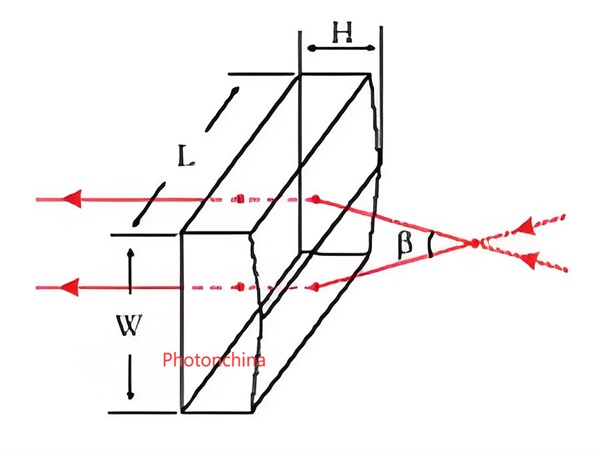
- Functions:
- Used at the eyepiece end of the endoscope to adjust the direction of the light path, allowing the physician to observe an upright image (rather than an inverted or reversed one).
- Reduces the overall size of the endoscope, making the device more compact (by folding the light path).
- Assembly errors for prism groups must be controlled at the micron level. If the perpendicularity deviation of the roof prism exceeds 0.1°, it can cause image ghosting or color separation, seriously affecting defect identification.
- Product Applications: Eyepiece systems of rigid endoscopes (e.g., cystoscopes, laparoscopes). Industrial endoscopes, where the image correction capability of the roof prism is particularly critical, such as in pipeline inspection within nuclear power plants.
II. Dove Prism
- Characteristics: The cross-section is an isosceles trapezoid. When light passes through, the image is inverted, but the optical axis direction remains unchanged. It enables 360-degree panoramic imaging through its rotational symmetry structure, typically requiring integration with complex optical systems, and is mostly used in special inspection scenarios.
- The optical path is illustrated in the figure below. For more details, please see our introduction of dove prism.
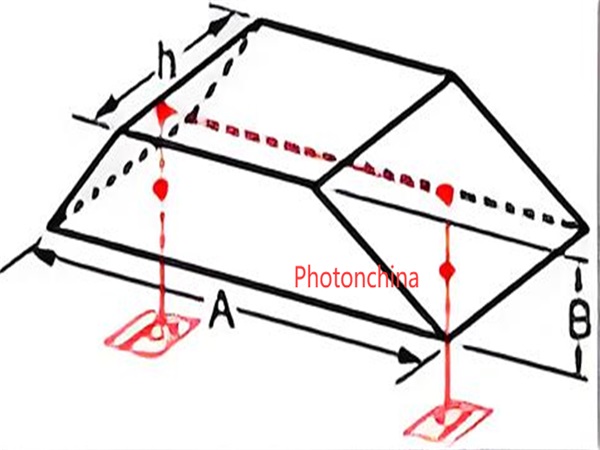
- Functions:
- Used in the relay system of the endoscope to correct the upside-down of the image, ensuring the final image has the correct orientation.
- Often used in scenarios requiring precise image orientation adjustment, such as systems combining surgical microscopes and endoscopes.
III. Right-Angle Prism
- Characteristics: Utilizes two perpendicular planes and the principle of total internal reflection to deflect light by 90° or 180°. It has a simple structure, but the image is not readable and requires combination with other prisms.
- The optical path is illustrated in the figure below.
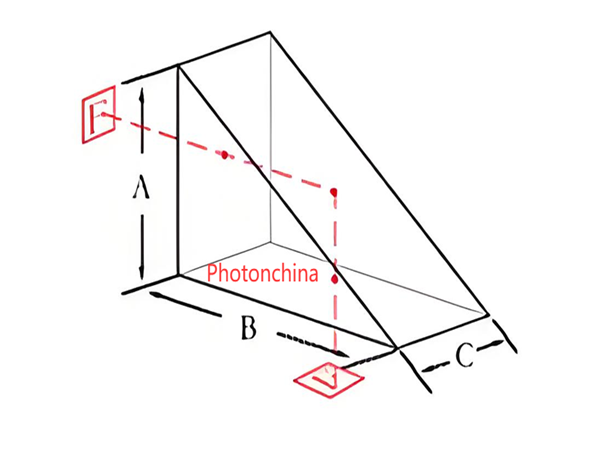
- Functions:
- Simplifies the optical path design of endoscopes. For example, in side-viewing endoscopes, a right-angle prism deflects the optical axis of the objective lens sideways, facilitating observation of pipe walls (e.g., in bronchoscopes).
- Acts as a beam splitter, cooperating with other optical elements to separate the illumination and imaging light paths.
IV. Pentagonal Prism
- Characteristics: Deflects the light path by 90 degrees and folds it, allowing the endoscope body to be slimmer, making it suitable for inspections in narrow spaces.
- The optical path is illustrated in the figure below.
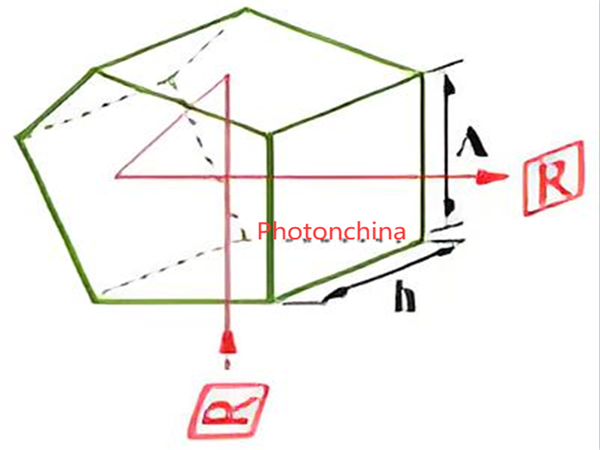
- Functions:
In rigid endoscopes, the prism group needs to introduce the light path from within the slender scope body towards the eyepiece direction. While a right-angle prism can deflect light by 90 degrees, a pentagonal prism enables more complex light path folding, allowing the endoscope to achieve imaging within a limited space.
- Product Applications:
In aero-engine blade inspection, the pentagonal prism ensures stable imaging of the probe within curved channels.
V. Wedge Prism
- Characteristics: Utilizes a wedge-shaped structure to adjust the angle of the light path, often used for fine-tuning the imaging direction. However, wedge angle errors must be precisely controlled to avoid image distortion.
- The optical path is illustrated in the figure below.
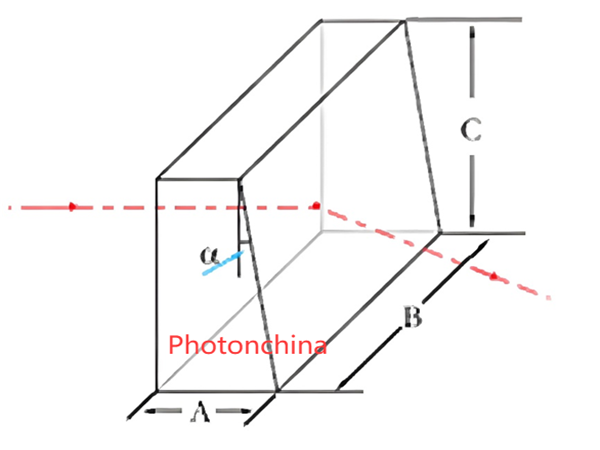
For more information bout wedge prism made by Photonchina, please see wedge prism.
VI. Porro Prism
- Characteristics: Composed of two right-angle prisms. Light changes direction after two reflections, and the image is laterally reversed (left-right).
- Functions: Used for light path deflection in early endoscopes. Additionally, adjusting the distance between the prisms can magnify the image. However, due to its larger size, it is gradually being replaced by roof prisms and is now only used in some low-cost devices.
Summary
In summary, optical prisms are the core components of the three-part “objective lens – image relay system – eyepiece” structure of the endoscope’s image system, primarily fulfilling two main functions: image orientation correction, and light path deflection/folding.
Meanwhile, the structural design and manufacturing of the prism or prism assembly directly determine the imaging quality.
Clarity
The manufacturing precision of the prism directly affects light transmission efficiency. Prisms made from low-dispersion materials like calcium fluoride or germanium, combined with high-quality optical coating technology, can reduce energy loss during light refraction. For instance, in our production, optimizing the coating process for roof prisms has increased light transmittance to over 95%, reducing image edge blurring by 40-50%.
Color Fidelity
The spectral characteristics of the prism material determine color reproduction capability. Quartz prisms have a low dispersion coefficient in the visible light range, allowing accurate reproduction of oxidation layer colors on metal surfaces. In contrast, ordinary glass prisms might cause a hue shift due to dispersion, leading to misjudgment of corrosion levels.
Multi-prism combinations require optical design to compensate for chromatic aberration. For example, in a three-prism system, adjusting the wedge angles and spacing of each prism can eliminate the axial offset of red and green light, making the image colors consistent with reality.
Field of View and Depth of Field
The incident angle design of the prism group affects the field of view. Wide-angle prisms can expand the inspection field of view but require balancing aberration control. Narrow-angle prisms, although offering a smaller field of view, provide a greater depth of field, making them suitable for detecting deep-seated defects.
Therefore, from design to manufacturing, high-quality optical prisms play a crucial role in both medical and industrial endoscopes.