PBS+Quarter Waveplate (optical isolator)
Product Introduction
A PBS combined with a half waveplate can form a polarization beam combiner (PBC), while a PBS paired with a quarter waveplate also has important applications.
Photonchina’s polarizing beam splitter (PBS) and quarter waveplate (QWP) can be fabricated into an optical isolator.
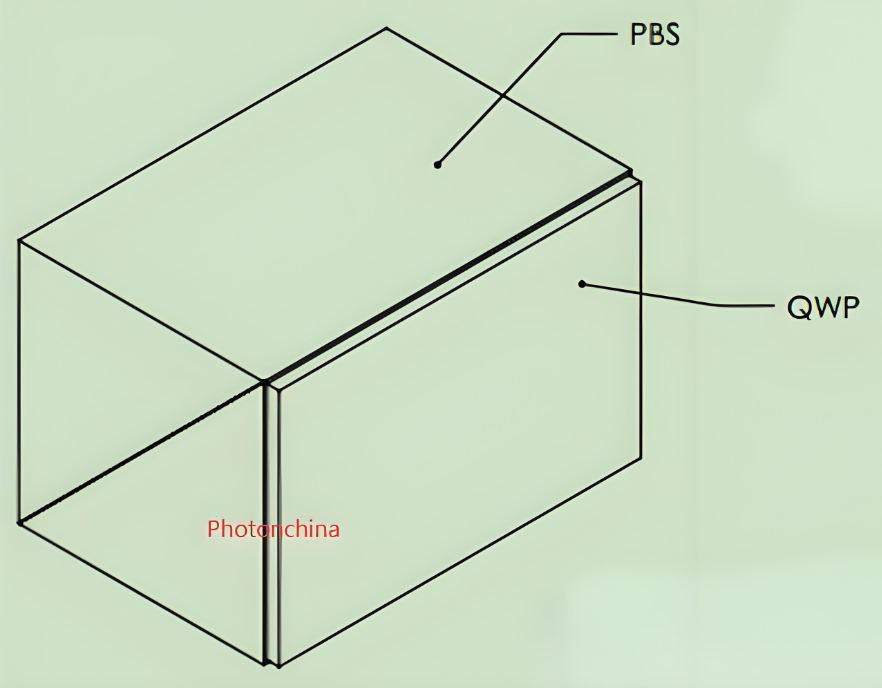
This isolator assembly consists of a PBS and a 1/4 waveplate, with the waveplate’s optical axis oriented at 45°. Transmitted P-polarized light passes through the waveplate and becomes circularly polarized light. Reflected light passes through the quartz waveplate a second time and turns into S-polarized light, which is then reflected by the PBS, achieving the isolation effect.
Specific optical path: A light beam is incident perpendicularly on the polarizing beam splitter (PBS), and emerges as linearly polarized light with a vertical polarization direction (P-polarized). The P-polarized light enters the quarter waveplate (QWP) and is converted into left-handed circularly polarized light (or right-handed circularly polarized light). Reflected right-handed circularly polarized light (or left-handed circularly polarized light) re-enters the quarter waveplate and is transformed into linearly polarized light with a horizontal polarization direction (S-polarized). The S-polarized light is then reflected by the PBS toward another direction.
This optical isolation configuration has low energy loss and is widely used in various interferometric systems.
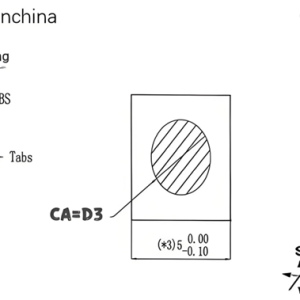
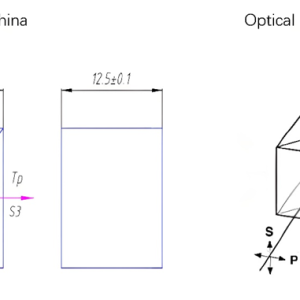
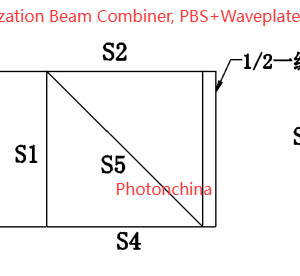
Product structure and optical path diagram are illustrated below:
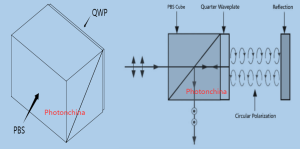
The PBS + QWP optical assembly produced by Photonchina features high-quality unidirectional transmission characteristics and precise polarization control capability, effectively eliminating back-reflection interference. We offer two different production technique options: adhesive cementing(NOA61) and enhanced optical bonding, ensuring excellent insertion loss and isolation (25–40 dB) for our customers. Dimensional accuracy reaches ±0.02 mm, surface quality is 40–20, and high-quality optical coating technology covers the operating wavelength range of 400–1700 nm. The product is compatible with multi-band light sources, withstands continuous-wave power up to several watts, and operates in environments from –45°C to 85 °C.
Typical Applications:
- Laser protection: preventing back-reflected light from damaging the light source.
- Fiber optic communications: improving signal transmission stability.
- Precision measurement: reducing optical path interference.
Frequently Asked Questions
Q: I’m a bit confused about the “combination of a polarizing beam splitter and a λ/4 waveplate.” This combination seems to only rotate the polarization direction of the incident light by 90 degrees—something a half-wave plate could also achieve. Why use such a complicated design?
A: Consider a reflection‑based imaging system, with the sample to be imaged on the far right and the laser on the far left. The light reflected from the sample surface is precisely the signal that carries the sample’s topographic information.
If you simply collect the reflected signal directly, you’ll encounter a serious problem: in addition to the desired sample‑reflected light, every optical element in the path (lenses, mirrors, etc.) will also reflect a portion of the light. This stray light introduces substantial noise, severely degrading image quality—especially in scanning‑based imaging.
This is where the PBS + QWP configuration shows its ingenuity: the QWP effectively isolates the sample from the preceding optics. Only light that passes through the QWP undergoes a change in polarization state, therefore the light reflected back from the sample and the reflected light in the previous optical path of the QWP are divided into two different polarization states. By placing a photodetector next to the PBS, you can collect the sample‑reflected light with high purity, dramatically reducing noise. This combination is widely employed in many optical imaging setups.
Q: The laser I’m using have a spec of 520nm -10nm/+10nm. While the spectral width (FWHM) is just 2nm, its center position can be anywhere in this range. We should measure the spectrum of several laser and observe the wavelength spread. So we need the waveplate to work from 510nm-530nm, not just 520nm+/-3nm (Low order waveplate) or 520+/-5nm (True zero order waveplate).
A: In this case, we recommend wideband PBS + Achromatic waveplate, which is used for such wide wavelength, say 420-680nm.
Achromatic waveplate is suitable for broadband operation. It combines two birefringent crystal materials with different dispersion characteristics (Quartz crystal and Magnesium Fluoride) to provide an approximately flat spectral response over a wide wavelength range, with phase retardation accuracy typically at ±λ/100.
However, please note that producing such assembly of broadband PBS cubes and Achromatic waveplates will see much higher price.
Brief Information About Optical Isolators
An optical isolator is a passive optical device that allows light to pass in only one direction. Its function is to prevent adverse effects on the light source and optical system caused by backward‑propagating light resulting from various factors in the optical path. For example, installing an isolator between a semiconductor laser source and the optical transmission system can significantly reduce the detrimental impact of reflected light on the spectral output power stability of the source. In high-speed direct modulation, direct detection fiber‑optic communication systems, backward‑propagating light generates additional noise and degrades system performance, which also necessitates the use of an optical isolator for suppression.
Therefore, optical isolators play an important role in fiber‑optic communications, optical information processing systems, fiber sensing, and precision optical measurement systems.
Types of optical isolators
There are many types of optical isolators. Classified by application, they include in‑line isolators and free‑space isolators; by working principle, magneto‑optic and all‑optical isolators; and by polarization characteristics, polarization‑dependent and polarization‑independent isolators. In addition, there are bulk isolators, thin‑film isolators, integrated waveguide isolators, single‑stage and dual‑stage isolators, etc.
One common operating principle of optical isolators is based on the Faraday effect. In this type of isolator, several widely used device structures are described below. Our company has long been a major supplier in the market, providing corresponding crystals, waveplates, and other components to domestic and international customers.
- Free‑Space Optical Isolator
A free‑space optical isolator consists of two polarizers, a Faraday rotator, and a magnetic ring. The transmission axes of the two polarizers are aligned at 45°, and the Faraday rotator provides a fixed 45° rotation angle under a saturated magnetic field.
- YVO4 Beam‑Displacer Type Optical Isolator
In some applications, a polarization‑independent optical isolator is required, which allows forward light to pass through regardless of its state of polarization. This is a polarization‑independent isolator based on the beam displacer, in this case, YVO4 BD, a type of YVO4 crystal prisms. It is composed of two YVO4 birefringent crystal components, a Faraday rotator, a half‑wave plate, a magnetic ring, and two fiber collimators.
- Crystal Wedge Optical Isolator
The structure of a crystal wedge optical isolator includes two fiber collimators and an isolator core. The isolator core consists of two birefringent wedge plates (e.g., LiNbO₃ crystal wedges), a 45° Faraday rotator, and a magnetic ring.
Parameters of PBS+QWP (optical isolator)
| Material | N-BK7(H-K9L), Fused Silica, Quartz Crystal |
| Size | 1*1*1mm~25.4*25.4*25.4mm |
| Clear Aperture | 90% |
| Surface Quality | 40-20 |
| Flatness | λ/8@ 632.8nm |
| Beam Deviation | <3′ |
| Production Technique | Cementing or Optical Bonding |
| Extinction Ration | 25-40dB |
| Optical Coating | Tp>97%,Rs>99% |
| Standard Wavelength | 532,633,780,795,1064,1550nm or Broadband such as 420-650nm, 1260-1670nm. |
| LIDT | 1-2 J/cm2 or 12 J/cm2 |
Specifications of PBS+QWP (optical isolator)
| Photonchina Code | Size (mm) | Wavelength (nm) |
| PBSQWP-11-532 | 1*1*1 | 532 |
| PBSQWP-22-532 | 2*2*3 | 532 |
| PBSQWP-55-532 | 5*5*5 | 532 |
| PBSQWP-10-532 | 10*10*10 | 532 |
| PBSQWP-12-532 | 12.7*12.7*12.7 | 532 |
| PBSQWP-20-532 | 20*20*20 | 532 |
| PBSQWP-25-532 | 25.4*25.4*25.4 | 532 |
| PBSQWP-11-633 | 1*1*1 | 633 |
| PBSQWP-22-633 | 2*2*3 | 633 |
| PBSQWP-55-633 | 5*5*5 | 633 |
| PBSQWP-10-633 | 10*10*10 | 633 |
| PBSQWP-12-633 | 12.7*12.7*12.7 | 633 |
| PBSQWP-20-633 | 20*20*20 | 633 |
| PBSQWP-25-633 | 25.4*25.4*25.4 | 633 |
| PBSQWP-11-780 | 1*1*1 | 780 |
| PBSQWP-22-780 | 2*2*3 | 780 |
| PBSQWP-55-780 | 5*5*5 | 780 |
| PBSQWP-10-780 | 10*10*10 | 780 |
| PBSQWP-12-780 | 12.7*12.7*12.7 | 780 |
| PBSQWP-20-780 | 20*20*20 | 780 |
| PBSQWP-25-780 | 25.4*25.4*25.4 | 780 |
| PBSQWP-11-795 | 1*1*1 | 795 |
| PBSQWP-22-795 | 2*2*3 | 795 |
| PBSQWP-55-795 | 5*5*5 | 795 |
| PBSQWP-10-795 | 10*10*10 | 795 |
| PBSQWP-12-795 | 12.7*12.7*12.7 | 795 |
| PBSQWP-20-795 | 20*20*20 | 795 |
| PBSQWP-25-795 | 25.4*25.4*25.4 | 795 |
| PBSQWP-11-1064 | 1*1*1 | 1064 |
| PBSQWP-22-1064 | 2*2*3 | 1064 |
| PBSQWP-55-1064 | 5*5*5 | 1064 |
| PBSQWP-10-1064 | 10*10*10 | 1064 |
| PBSQWP-12-1064 | 12.7*12.7*12.7 | 1064 |
| PBSQWP-20-1064 | 20*20*20 | 1064 |
| PBSQWP-25-1064 | 25.4*25.4*25.4 | 1064 |
| PBSQWP-11-1550 | 1*1*1 | 1550 |
| PBSQWP-22-1550 | 2*2*3 | 1550 |
| PBSQWP-55-1550 | 5*5*5 | 1550 |
| PBSQWP-10-1550 | 10*10*10 | 1550 |
| PBSQWP-12-1550 | 12.7*12.7*12.7 | 1550 |
| PBSQWP-20-1550 | 20*20*20 | 1550 |
| PBSQWP-25-1550 | 25.4*25.4*25.4 | 1550 |
Note: The default isolation level for the above standard products is >25-30db.
For high isolation or wideband products, please contact our sales team: sales@photonchinaa.com.