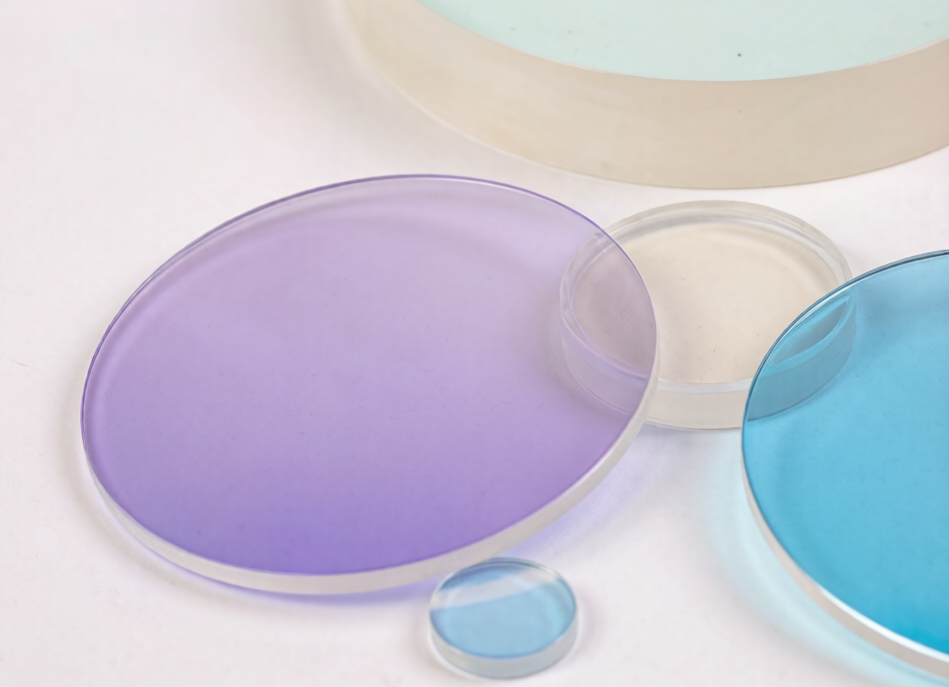
Product Introduction
A dichroic mirror, also referred to as a dichroic filter, color separation mirror, or dichroic beamsplitter, is a high-precision optical element that selectively reflects or transmits specific wavelengths of light based on the principle of optical thin-film interference. It can almost completely transmit light of certain wavelengths while reflecting light of other wavelengths, thereby achieving highly efficient spectral separation. Unlike absorptive filters, dichroic mirrors handle non-transmitted light through a reflective mechanism, which allows them to withstand higher-intensity light sources without generating excessive heat through absorption.
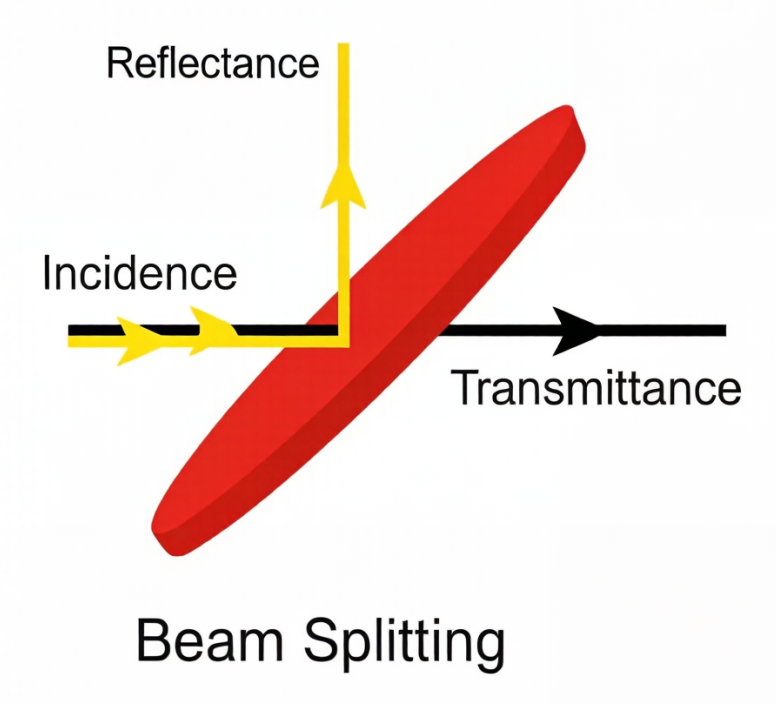
Dichroic mirrors are typically used at a 45° angle of incidence, so that the reflected and transmitted beams are separated by 90° orthogonally, greatly facilitating optical path design and spatial layout.
Working Principle
The core operating principle of a dichroic mirror is based on thin-film interference effects. On a high-quality optical substrate (such as UV fused silica, N-BK7 glass, etc.), tens or even hundreds of dielectric thin-film layers with different refractive indices are deposited through a vacuum coating process. The thickness and refractive index of each layer are precisely engineered through sophisticated optical design. When polychromatic light strikes the mirror surface, specific wavelengths undergo constructive interference and are efficiently transmitted, while non-target wavelengths undergo destructive interference and are efficiently reflected.
Advantages of this design include:
- High transmittance/reflectance: Transmittance within the working band can exceed 90%, and can even reach T>98%, R>98% sometimes.
- Sharp spectral cut-off: A steep transition between transmission and reflection enables precise wavelength “slicing.”
- Low absorption, low loss: Most of the light energy is effectively utilized rather than converted into heat, making it suitable for high-power applications.
- Long lifetime: Hard coating processes are employed to produce stable, dense film layers that ensure long service life.
Application Fields
- Fluorescence Microscopy and Life Sciences
Dichroic mirrors are core optical components in fluorescence microscopy. They are used to reflect excitation light onto the sample while transmitting the fluorescence emitted by the sample to the detector, therefore achieving efficient separation of excitation and emission light for high contrast, low background noise imaging. - Laser Systems
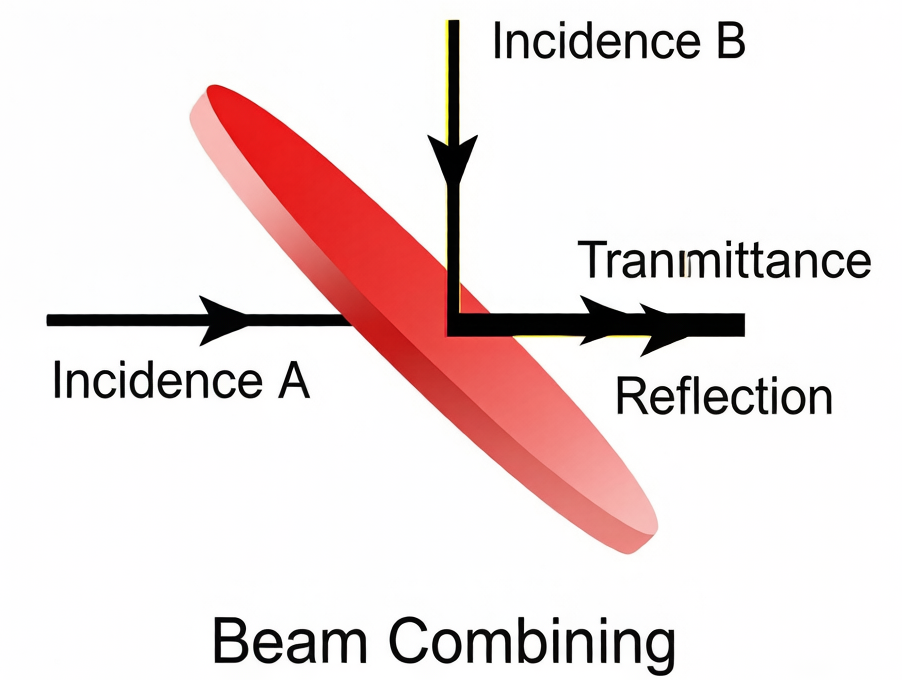
In laser processing, laser beam combining or splitting, optical isolators, and multi-wavelength laser systems, dichroic mirrors are used to precisely manipulate and combine laser beams of different wavelengths for output or spectral analysis. - Flow Cytometry
They are suitable for separation of optical signals emitted by different fluorescent labels, enabling multi-parameter cell analysis and sorting. - Machine Vision and Industrial Inspection
In industrial inspection and imaging modules, dichroic mirrors split different spectral bands, such as infrared and visible light, to facilitate multispectral analysis. - Projection Display and Illumination
In projection light engines, they are responsible for the precise combination or separation of red, green, and blue primary colors. In stage lighting and architectural illumination, they create rich color effects.
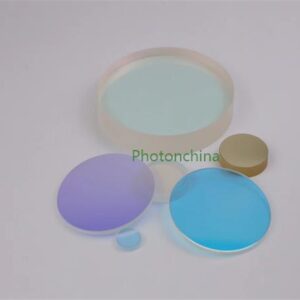
In summary, a dichroic mirror is an optical element that separates light beams according to wavelength. By applying a filter coating on one surface and an anti-reflection coating (AR Coating) on the other surface of an optical substrate, dichroic mirrors exhibit high transmission or high reflection properties for different wavelength beams. They are therefore commonly used to split or combine beams of different wavelengths, or even to filter out a specific wavelength band.
Photonchina Product Specifications
Based on spectral characteristics and functional requirements, dichroic mirrors are mainly divided into the following types:
- Long-pass Dichroic Mirrors (High-pass)
These have high transmittance for longer wavelengths and high reflectance for shorter wavelengths. They are suitable for applications that require extraction of long-wavelength signals while suppressing short-wavelength noise. - Short-pass Dichroic Mirrors (Low-pass)
High transmittance for shorter wavelengths and high reflectance for longer wavelengths. They are often chosen for applications requiring extraction of short-wavelength signals and removal of long-wavelength interference. - Multi-band Dichroic Mirrors
Featuring three or more transmission or reflection bands, these mirrors can operate across multiple wavelength regions simultaneously, making them highly useful for multi-photon imaging and complex multi-path optical systems.
Based on the application scenario, dichroic mirrors can also be categorized into medical dichroic mirrors, optical path monitoring dichroic mirrors, ultraviolet dichroic mirrors, and other types.
Photonchina offers an extensive selection of wavelengths, covering a broad spectral range from ultraviolet to near-infrared: 490 nm, 505 nm, 550 nm, 605 nm, 638 nm, 650 nm, 805 nm, 950 nm, 1000 nm, 1180 nm, 1500 nm, 1800 nm, and many more. Custom wavelengths are also available.
In terms of geometry, in addition to conventional square and circular shapes, we offer a variety of optical assemblies, such as combinations of multiple prisms. By utilizing cementing or our proprietary optical bonding technique, Photonchina provides precision optical assemblies of multiple prisms or lenses that incorporate dichroic mirror/filter functions.
Please see our prism assembly product examples here.
Technical Parameters
| Material | Fused Silica, N-BK7 |
| Size | 1mm-200mm, Optical assembly services available. |
| Clear Aperture | 90% |
| Surface Quality | 20-10 |
| Flatness | λ/8@ 632.8nm |
| Parallelism | <3′ |
| Incident Angle | 45°, or specify. |
| Transmittance
Reflectance |
Tavg>90%, Tabs>85% (Long/Short Pass), Tavg>90% (Multi-Band)
Ravg>90%, Rabs>85%( Long/Short Pass),Ravg>95% (Multi-Band) |
| Common Wavelength | 490 nm、505 nm、550 nm、605 nm、638 nm、650 nm、805 nm、950 nm、1000 nm、1180 nm、1500 nm、1800 nm. |