
In optical communications, the “lens” is essentially a passive optical component within TOSA/ROSA that performs beam collimation, focusing, and coupling into the fiber core (or from the core to the detector). In fact, without the optical lens, the light emitted from the optical chip would not be able to couple into the optical fiber. Serving as the “last-mile” precision optical bridge for optical modules transitioning from electrical interconnection to optical interconnection, the lens is a small but crucial link in the entire industrial chain. As the “invisible heart” of AI-driven optical interconnect, it is becoming a key enabler for the mass deployment of 800G/1.6T high-speed optical modules and the future widespread adoption of 3.2T optical modules.
The explosive growth in demand for AI computing power and the comprehensive acceleration of data center construction in recent times have brought unprecedented opportunities to the high-speed optical module and core device market, leading to a surge in demand for lens products. According to LightCounting, the global optical module market is projected to reach $63.8 billion by 2031. The global market for high-speed data communication optical modules (400G/800G/1.6T) is expected to hit $35.25 billion in 2026, representing a growth rate of 136.5%. This sharp increase in orders for high-speed optical modules has directly driven substantial growth in demand for core components and key materials.
However, as a specialized manufacturer with over 25 years of deep experience in the optical communication lens industry, Photonchina takes a more measured view of this demand surge. There is a wide variety of lenses used in optical communications, each with its own technique barriers, production capacity, and downstream applications, leading to distinct supply-demand dynamics. We personally participated in the entire process of C-lens development, from initial R&D, prototype process to mass production, and gained firsthand experience with the “characteristics” and market rhythms of numerous related lenses.
Lenses used in optical modules are made from different materials, and the choice of material depends on its physical properties—such as refractive index, thermo-optic coefficient, stability, and transmittance—which determine its suitability for different application scenarios. Below, we briefly discuss several mainstream lens types currently in use.
Silicon Lens – The Workhorse of Mass Production
Currently, silicon lenses boast the largest production capacity and market share. Industry estimates suggest an annual production capacity of at least 390 million units. Their manufacturing process shares much in common with the semiconductor industry, primarily using photolithography and micro/nano fabrication techniques. This enables high precision and easy mass production, which is key to their rapid market dominance. Notably, silicon lenses have a natural advantage in material compatibility—as optical module rates escalate to 800G, 1.6T, and beyond, silicon lenses match better with silicon photonic modules. Leading optical module manufacturers have already largely shifted to silicon photonic solutions for 800G and higher-speed products.
The core application of silicon lenses is precisely the current booming data center market. Behind everyday activities like short video browsing, instant messaging, and various cloud data storage, data centers bear the burden of information transmission and computation. Silicon lenses are installed inside the high-speed optical modules of these data centers, responsible for collimating, focusing, and coupling light from optical chips.

Glass Aspherical Lens – The Versatile All-Rounder
The core manufacturing process for glass aspherical lenses is precision thermal molding (including both continuous and multi-station molding). Although the initial mold investment is high, the advantages are excellent consistency in batch production and high optical precision, making it suitable for large-scale, high-reliability industrial applications. Overall demand in downstream application areas for glass aspherical lenses remains strong.
Some data suggests that the global optical communication aspherical lens market will reach $875 million by 2032, with a compound annual growth rate (CAGR) of approximately 7.4% from 2026 to 2032. The application scenarios for glass aspherical lenses are extremely broad—beyond medium- and high-speed optical modules in data centers, they are also widely used in optical communication equipment for 5G base stations: the 5G signals used by mobile phones are relayed through base stations, where the optical modules employ glass aspherical lenses to ensure long-distance, high-quality signal transmission. Additionally, in high-end applications such as industrial laser processing and medical laser treatments, glass aspherical lenses play a critical role. Their high precision meets the stringent requirements for beam collimation, coupling, and focusing in various advanced devices.
C-LENS – The Classic That Has Witnessed Industry Change
In the passive optical communication field, C-LENS and G-lens or GRIN LENS (gradient-index lens) are the most common types. As a manufacturer who was involved from the initial invent and development to the mass production of C-lenses, we have witnessed the entire evolution of this product over decades. We have seen its journey from a “value-for-money dark horse” that replaced G-LENS, to becoming a standard component in optical modules, and then gradually retreating to niche markets under the wave of silicon lenses.
The C-lens was originally created to replace or partially replace the then-expensive GRIN LENS. It offers excellent customization, ease of assembly, small space occupation, and outstanding cost-effectiveness, making it the preferred choice for most optical modules for a long time—truly the big brother of the industry.
However, industry estimates put current annual demand for C-lenses at around 70–80 million units, with total industry demand not exceeding 150 million units per year. The reason is that C-lenses rely on traditional cold processing techniques, mainly manual with semi-automated operations, resulting in a relatively slow production rhythm and difficulty in achieving fully automated mass production. After silicon lenses began to proliferate in 2019, C-lenses were widely replaced in the optical module market.
Nevertheless, C-lenses have not completely disappeared; they are still primarily used in low-to-medium speed, small-batch optical module applications, such as optical fiber transmission modules for surveillance equipment, fiber optic interfaces in small and medium-sized routers, and some custom industrial optical communication equipment. These applications do not require high single-batch capacity but emphasize cost-effectiveness.
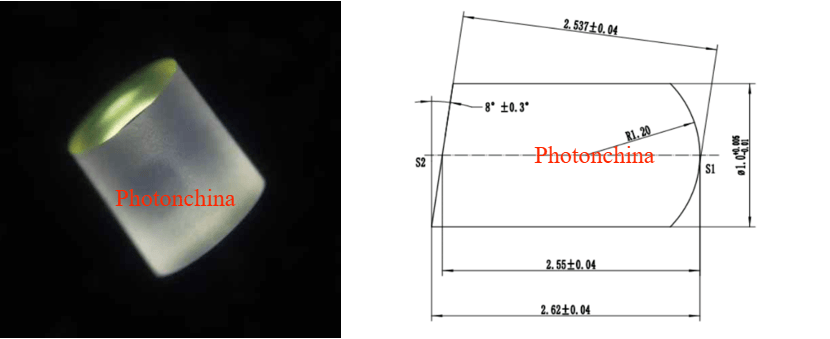
C-lens: physical image and standard size specifications
Plastic Lens – The Economical and Lightweight Choice for Short-Reach Transmission
Plastic lenses have carved out a position in the SR (short reach) module market. This is due, on one hand, to the strong demand for large-scale deployment of SR modules, and on the other hand, to the inherent advantages of plastic lenses: low cost, light weight, and ease of mass production. The manufacturing process is in large part injection molding, similar to the molding process for glass aspherical lenses, but with greater advantages in mass production cost and equipment volume, making it suitable for widespread deployment.
The application scenarios for plastic lenses are focused on short-reach optical transmission. Typical examples include short-reach optical signal connections between different servers within a data center, fiber optic connections within local area networks in office buildings, and short-reach fiber transmission between a home optical modem and a router. In these scenarios, long-distance transmission is not the core requirement, while cost sensitivity is high. Plastic lenses fit this market positioning perfectly, and their lightweight nature also enables smaller terminal devices.
Summary and outlook from industry veterans
From our perspective as a specialized manufacturer, the expansion of AI computing power and the accelerated construction of data centers are profoundly reshaping the market landscape for optical communication lenses.
According to TrendForce forecasts, the combined capital expenditure of the world’s top eight cloud service providers is expected to further increase to over $600 billion in 2026, representing an annual growth rate of 40%. Meanwhile, the market size for 100G and higher pluggable optical modules is projected to grow from nearly $20 billion in 2025 to over $50 billion by 2030, and the co-packaged optics (CPO) market is expected to reach $10 billion by 2030.
Passive components such as lenses, prisms, and wavelength division multiplexing devices, responsible for optical signal transmission and precise coupling, account for approximately 11% of the optical module BOM. As speeds increase to 1.6T and beyond, alignment accuracy requirements rise to the submicron level, driving the continuous evolution of processes from traditional optical fabrication to semiconductor micro/nano manufacturing.
As veterans who have witnessed and are deeply involved in the field of optics for over two decades, we understand that on the long chain of optical communication, lenses are small but hold significant weight. Without them, optical signals would be immobilized, the massive throughput of data centers and the convenient experience of fiber-to-the-home would be reduced to nothing. Therefore, continuously providing high-quality micro-lenses to the market has always been an important task for our company
Disclaimer: Some of the data and forecast in this article are derived from publicly available information and our years of industry experience. This only represents the author’s perspective and is for reference only.