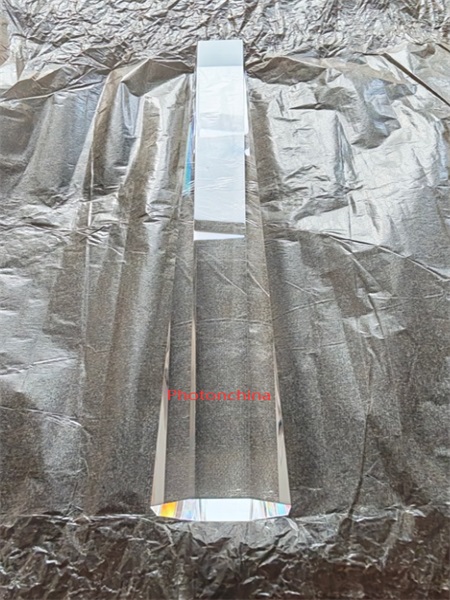
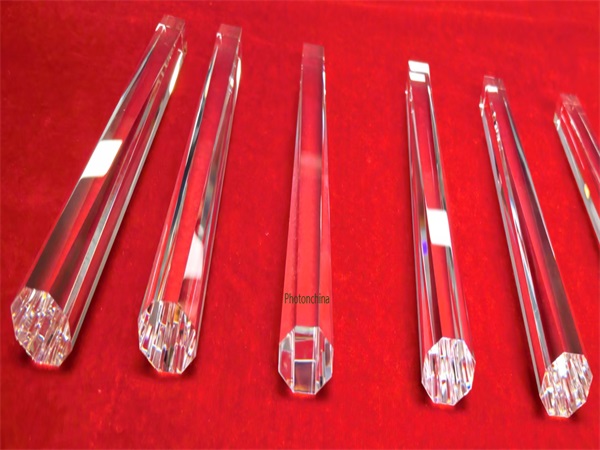
Product Introduction
I. Product Overview
A light pipe, also called a light homogenizing rod or light guide rod/prism, is a precision optical component that operates based on the principle of total internal reflection(TIR). It is used to collect, transmit, and homogenize divergent light emitted by a light source, forming a uniform light spot or stable light column at the output end. Its core working principle is as follows: When light travels from an optically denser medium (e.g., glass) to an optically rarer medium (e.g., air), total internal reflection occurs at the glass-air interface when the angle of incidence exceeds the critical angle. The light is “locked” inside the rod and propagates repeatedly until it exits from the output end. This process does not rely on any reflective coating, and regardless of the spectral characteristics of the incident light source, a homogenization effect can be achieved.
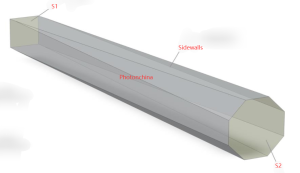
II. Material Selection: Fused Silica vs. N-BK7 (K9) Optical Glass
The performance of a light pipe rod first depends on the optical and thermal properties of the substrate material. Fused Silica and BK7(K9) optical glass are two mainstream choices, corresponding to different application requirements.
K9 optical glass, or H-K9L (Chinese equivalent of N-BK7), belongs to barium crown optical glass and is melted from a formulation of SiO₂ with metal oxides such as barium oxide and boron oxide. It has a refractive index n_d ≈ 1.5168 and an Abbe number of approximately 64.2, offering high transmittance and low dispersion in the visible to near-infrared region. Its process is mature and its cost is low, with the cost of products of the same specifications being only a few tenths of that of fused silica, making it the preferred material for general-purpose optical instruments. However, K9 contains alkali metal oxides, exhibits noticeable absorption at wavelengths below 350 nm, and may undergo surface corrosion in humid or weakly alkaline environments.
Fused Silica, quartz glass, Corning 7980 or JGS1, uses high-purity SiO₂ as its raw material, with a purity of over 99.99% and a refractive index of approximately 1.458. Its transmission window can extend to the deep ultraviolet region of 185–195 nm, covering a broad wavelength range of 200–2200 nm. Its coefficient of thermal expansion is only 0.55×10⁻⁶/°C (K9 is approximately 7.1×10⁻⁶/°C), resulting in extremely small changes in geometric dimensions under severe temperature fluctuations. In addition, the total amount of metal impurities in synthetic fused silica can be controlled below 1 ppm, and its laser-induced damage threshold (LIDT) is far higher than that of K9, making it suitable for high-power laser transmission scenarios.
| Data | K9, N-BK7 | Fused Silica, Corning 7980 |
| Refractive Index(587.6nm) | 1.5168 | 1.458 |
| Abbe | 64.2 | 67.8 |
| Transmission Region | 350-2100nm | 185-2200nm |
| Coefficient of Thermal Expansion | ~7.1×10⁻⁶/℃ | ~0.55×10⁻⁶/℃ |
| LIDT, Damage Threshold. | Medium | High |
| Cost | Low | High |
Selection Recommendations: For conventional visible and near-infrared illumination, beauty devices, stage lighting, and similar applications, K9 glass is preferred. For deep-ultraviolet applications, high-power laser transmission, wide-temperature-range environments, or occasions with strict requirements for chemical stability, fused silica, like corning 7980/7979/7978, or JGS1/JGS2/JGS3, Chinese equivalent, should be selected.
III. Coating Solutions: Anti-Reflective Coating (AR Coating) and Uncoated
The end-face treatment of a light guide rod is a key factor affecting transmittance. When light enters glass from air, each interface produces approximately 4% Fresnel reflection loss, resulting in a total loss of about 7–8% at both end faces. To address this loss, we offer two options: coated and uncoated.
Uncoated light guide rod transmits light by means of total internal reflection, with no additional treatment on the end faces. They are suitable for cost-sensitive applications where transmittance requirements are not extreme. Their sidewall total internal reflection efficiency is close to 100%, and the overall transmission depends on reflection loss at the end faces.
AR coating, i.e. anti-reflection coating, involves depositing one or more layers of optical thin films on the light input end face (entry face) and/or light output end face (exit face) of the light pipe, using the principle of interference of light reflected from the upper and lower surfaces of the film to reduce reflectance. After AR coating on one side, transmittance can be increased from approximately 96% to over 99%. Commonly used coating materials include HfO₂, TiO₂, SiO₂, Ta₂O₅, etc., and the coating design can be customized according to the operating wavelength.
In addition, high-reflection coatings, beam splitter coatings, or metal coatings can be made on the end faces as required, and uniform light output can also be achieved through diffusion treatment. The choice of coating solution should comprehensively consider the operating wavelength, power density, environmental conditions, and cost budget.
IV. Typical Application Fields
Laser Beauty and Medical Treatment: light pipes or light homogenizing rods/prisms are used in beauty devices such as 808 nm semiconductor lasers and IPL intense pulsed light systems to concentrate and transmit laser energy vertically to the treatment window, reducing energy loss and discomfort caused by lateral scattering. Conical light pipes (taper light pipes) are also used in dental Er:YAG laser systems.
LED Illumination Homogenization: Hexagonal or octagonal light pipes convert the non-uniform output of LEDs into uniform light spots, and are widely used in projection systems, UV curing equipment, and machine vision lighting.
Optical Communications: Fused silica light guide rod arrays are used to transmit multiple optical signals from a light source to a fiber array. Combined with microlens arrays for further focusing or beam splitting, they improve coupling efficiency.
Endoscope Illumination: Miniature light guide rods guide LED light to the field of view at the endoscope tip. Through multiple total internal reflections, they improve light energy utilization, enhance illumination effects and imaging quality.
Stage Lighting and Industrial Inspection: Light homogenizing rods are used for color mixing and light homogenization in stage lighting, as well as for uniform illumination in industrial inspection systems, ensuring consistency and reliability in inspection.
Product Classification
The cross-sectional shape and axial geometry of a light pipe directly affect output uniformity and spot morphology. We offer a variety of specifications, including square (four-sided), hexagonal, octagonal, cylindrical, and tapered (with different sizes at the two ends) types.
Square (four-sided) light pipe rod, N-BK7 homogenizing light pipe rod, is the most basic geometric form. It is easy to process and suitable for applications with less stringent uniformity requirements. Light reflects alternately among the four flat surfaces, and the output spot is rectangular in distribution. It is commonly used in laser beauty devices for concentrated energy transmission.
Hexagonal light guide rod, fused silica homogenizing cylindrical light pipe, is significantly superior to the square structure in homogenization performance. The hexagonal cross-section increases the number of reflecting surfaces, causing light to undergo reflections in more directions during propagation, greatly improving output uniformity. Compared with square light pipes, the hexagonal shape can reduce optical loss by approximately 30-40%. The hexagonal structure offers the best balance between processing cost and optical performance, and is widely used in LED illumination homogenization, medical imaging systems, and industrial inspection equipment.
Octagonal pipe light, octagonal prism, further increases the number of reflecting surfaces, bringing spot uniformity to a higher level. The more facets, the more uniform the spot. The octagonal structure is suitable for precision optical systems with extremely high requirements for spot uniformity, such as laser projection and high-precision imaging illumination.
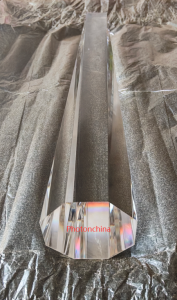
Cylindrical light guide rod (rod-shaped) has a circular cross-section. Light reflects continuously on the cylindrical surface, and the output spot is distributed in circular pattern. It is ideal for applications requiring a circular uniform spot, such as endoscope illumination and fiber coupling. Cylindrical light guide rods require high processing precision.
Tapered light pipe rod, or conical homogenizing cylindrical light pipe (with different sizes at the two ends), is a special geometric design. The cross-sectional dimensions of the input end and output end are different, and common magnification ratios are 2X, 3X or customized. While homogenizing light, the tapered structure can proportionally reduce the numerical aperture (NA) of the output light and can magnify or reduce the beam by adjusting the size ratio between the two ends. This characteristic makes it excellent for use with LED light sources, offering unique advantages in applications requiring control of the beam divergence angle.
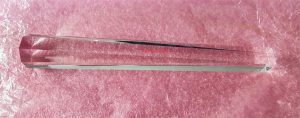
Other Custom Light Pipes.
What is more, we can provide tailored optical components or precision assemblies according to customers’ individualized requirements, based on technical drawings or specific instructions.
| Section type | Spot shape | Uniformity | Typical applications |
| Four-sided
(Square) |
Rectangular | Moderate | Laser cosmetic devices,
Basic lighting |
| Hexagonal Prism | Hexagonal | Good
(light loss reduced by 30-40%) |
LED homogenization,
Medical imaging |
| Octagonal Prism | Octagonal | Excellent | Precision projection,
High precision illumination |
| Cylinder | Circular | Good | Endoscopes, Fiber coupling |
| Taper
Conical |
Depends on cross-section | Excellent | LED homogenization, NA control |
Technical Parameters
| Material | Fused Silica (Corning 7980,7978,7979), N-BK7 (H-K9L) |
| Cross section shape | Square, hexagonal, octagonal, cylindrical, tapered/conical (2X/3X/5X magnification) |
| Dimensions | Diameter 0.7 mm–100 mm, length 5 mm–300 mm;
Product combination and assembly services available |
| Tolerances | ±0.1 mm, ±0.05 mm, ±0.01 mm, multiple precision grades available. |
| Clear Aperture | 85%-90% |
| Surface Quality | 60/40, 40/20, 20/10 |
| Flatness | λ/2, λ/4, λ/10 @ 633 nm |
| Parallelism | <3′, <5′, <10′ |
| Incident Angle | 0°, 45°, or specify. |
| Coating options | Uncoated;
Single/double face AR coating, high-reflection coating, beamsplitter coating, metallic coating. |
| Chip | Standard 0.1 mm;
Premium: 0.05mm, 0.02mm. |